Showing posts with label health. Show all posts

Thursday, February 18, 2010

Make Your Computer a Little More Primal with F.lux


I have been experience problems getting to sleep lately.

I'll come home from a long day of work/exercise/running-around-like-a-crazy-person, get settled and feel nice and sleepy.. then I get this sudden urge to check my Twitter, Google Reader, e-mail and all that.  And like magic, I am no longer tired.  

Well, that's not true - I'm still exhausted -  but that feeling you get right before you drift off into La La Land is obliterated.  One reason for this, I believe, is that it gets your brain working a little faster than it would like to in the late evening, essentially waking it up ("oh, that's interesting" "oooh, I can blog about that later" "WHAT?! Somebody's WRONG on the INTERNET?!!")  Another definite problem is that the bright, glaring lights of the computer screen, especially in contrast to the darkness around it, can disrupt your body's melatonin levels, as researchers discovered years ago.  Melatonin is necessary for achieving high quality sleep.


Sleep is incredibly important - not only to us Paleo diet enthusiasts or Primal life lovers, but to EVERYONE.  A fair bit of us here in America are getting less than 6 hours of sleep, which is simply not enough to let the body do all the things it needs to do during this mandatory downtime.  
"Stage Four: Though everything has slowed, this deep sleep marks an increase in activity. The body's blood pressure drops and muscles relax, though blood flow to muscles increases. Dreams continue and sleepwalking is most likely, caused when there is a disruption of the brain's command to paralyze muscles so that people do not act out their dreams. This is the most restorative sleep, releasing hormones for growth and development, repairing tissue and refreshing energy.  Awakening in deep sleep is difficult; a person would remain groggy and disoriented for a few minutes." - E.L. Miller
Hopefully it is clear that sleep is very important for us in our busy, active lives - especially moreso if you are engaged in physical activity.


Thankfully, I found something to help make my computer a little more Primal, alleviating some of my computer-related sleep problems.  But first a little background on the 'why' and the 'how' of digital-age insomnia.

What Is Melatonin?


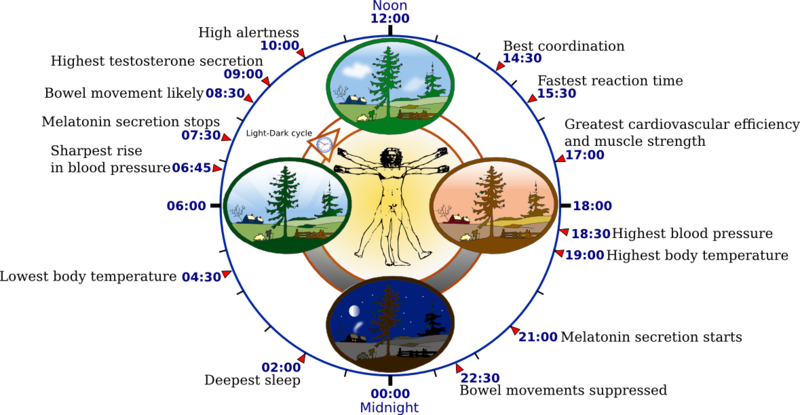
The pineal gland generates melatonin - interestingly, it is light sensitive. There is a very complicated hookup between the pineal gland and your eyes - essentially it knows when daylight (or artificial daylight from blue-light heavy screens like cell phones, computer monitors and televisions) is hitting your eyes, and then melatonin synthesis is suppressed; conversely, when lower spectrum "red" light (think sunsets!) starts hitting your eyes, or the absence of light altogether, it tells the pineal gland to get movin'!

Quite a useful chemical, melatonin is made all over the body, mostly in the skin (where it serves other and varied functions) and the pineal gland, located in the brain, where it serves as a sleep regulator.  Melatonin is manufactured from the neurotransmitter serotonin, which is created by the amino acid tryptophan.

Melatonin doesn't necessarily make you fall asleep, but works more as a "time cue", essentially telling your brain, "Now is probably a good time to take a break, yanno?"  This makes it a very important element in our Circadian Rhythm, or our biological clock.   When we start screwing with our biological clock, bad things start to happen.


Computer, Phone and Television Screens - Oh my!

As mentioned above, blue light suppresses melatonin production. It is emitted by some lamps, UV lights, computer monitors, television screens and hand-held devices... actually, most artificial light sources, as can be easily seen in the picture in the beginning of this article.   Not only does this contribute to insomnia via late-night computing or TV viewing, but it has several deleterious effects on our vision, to boot.

The obvious solution to this problem?  When it starts getting dark, turn off the lights, turn off the TV, turn off the computer and the cell phone, light up a couple of candles or or soft-light lamps - or better yet, a roaring fireplace. Mmmm.  Spend the rest of the evening conversing with your friends and loved ones or reading a book by firelight.

Unfortunately, this is not going to be a feasible option for many.  We either do not have the resources to do this (candles don't create THAT much light, and I sadly do not have a fireplace in my apartment) or are too caught up in the cycles of the modern world to comfortably do things like that.  I am definitely guilty of this - still working on limiting my compulsive e-mail and social networking compulsions.

So what am I to do?

Try F.lux for Mitigation!


Thankfully a Stereopsis has addressed this problem with a piece of software calle F.lux.  F.lux takes your location information (via zipcode or latitude/longitude) and determines what phases in the night-day cycle you are (adjusting for seasons and daylight savings time and all that).  It then adjusts your computer's display settings to either mimic daylight or, using settings you can specify, mimic the quality of your indoor lighting.   


I set mine to be nice and "halogeny", similar to the picture to the left.  You should be able to see the difference between a computer with F.lux (top monitor) and a one without (laptop).  

My brother brought this program to my attention the other day - he called me over and told me to "look at this";  there wasn't anything on the monitor, but it was weirdly colored.. and it honestly made me feel sleepy just looking at it!

I installed it immediately, and am very glad I did.   It takes a little adjustment, but you get used to it after a little while; it also comes with an option to easily disable it, just in case you have some color-sensitive work to do.

My favorite part?  It's completely free and runs on Windows, Mac OS AND Linux.  Woot!

I hope you at least give this program a try - the mitigation of eye strain and prevention of sleep deprivation this can provide are potentially priceless.  May not work for everyone, but like I said - it's free and a way to make your everyday life a touch more Primal!


ZA5UG8X82GJT - for TechnoRati


Thursday, February 4, 2010

Putting Some Cracks in the Myth of Cholesterol - With a Word on Grains


Had an interesting series of conversations on Reddit today.  (If you're interested in joining in, go here [guess which one is me].)

In the Fitness sub-Reddit, someone asked:
I'm trying to get stronger by lifting weights and eating all the time. My dad says he has never seen anyone in his life eating like I do and is concerned that I am causing irreversible damage to my body. I don't intend to eat 6 eggs a day for the rest of my life.. just until I gain 20 pounds or so of muscle... So what should I tell him, or should I listen to my old man and have maybe 1 egg a day?
To which I responded:

Most people that have heart attacks do not have high levels of blood cholesterol. ACTUALLY, as the amount of serum cholesterol lowers, mortality increases.  From the Framingham Study (longest running cohort study, ever - since 1948): There is a direct association between falling cholesterol levels over the first 14 years and mortality over the following 18 years."

Cholesterol is good. Saturated fat is great. (Saturated fat increases serum cholesterol, but this is actually a good thing). They do not CAUSE heart attacks. Cholesterol oxidation DOES, however. Cholesterol is oxidized by the presence of blood glucose and trans fatty acids. They interact with LDL (which are necessary for proper body function) and turn them into... DLDL (yes, silly, I know) dense low-density lipoprotein. It's not HDL, but an entirely different beast. One that gets stuck in arterial walls. This in turn can cause oxidation of the surrounding tissue, creating inflammation that if left unchecked will cause lesions which will eventually 'scab over' with more cholesterol. Cholesterol that will be in your blood regardless of how much you eat because a healthy liver makes it, as it is a prerequisite for cellular life and function.

The "experts" that tout this cholesterol myths are doctors or, worse, dieticians that either do not have a degree in physiology or a solid understanding of these underlying processes, or are under the thumb of Big Pharma and would love NOTHING more than to get you hooked on statins instead of altering your lifestyle and preventing heart disease without having to pay them.

This went back and forth a while - eventually the topic of grain became a focus:
I agree with your original post and what came out of that, but you can't say that all of these health problems that we face today were caused by grains. Your use of "Civilization" has to assume that either ancient civilizations (like the Sumerians and Chinese, which had cultivated grain and pulse crops over 10,000 years ago) were rife with obesity and heart disease, or that these crops are new in our diet. True, the composition of what we refer to as "grains" has changed a lot with processing, but you can't argue that, for example, Africans who live primarily off grains like sorghum and pulses/beans are diabetic or obese.
And my response:

These Africans are also eating far less than we are, and are extremely active.  Apples and oranges comparison - they do not really live in a "land of plenty" scenario.  That does not say that these foods are necessarily good for them - just because you're not overweight does not mean your body isn't suffering from the inflammatory and oxidative effects of the phytates, lectins and gluten in grains.

A problem with agriculture is that it allows for more people to survive on less - you have explosions of populations of people that can subsist on nearly nothing because they do not have to work as hard physically for our food.  This leads us to the massive slum populations in places like India andmany places in Africa, where agriculture was introduced, populations exploded, famine becomes the norm.

And grains are very new to our diet.  Homo sapiens sapiens has been around for 200,000 year, possible more.  Most evidence points to agriculture being around 10,000 years old, making grain, at most, a part of diet for 5% of our history.

An unfortunate byproduct of agriculture is that it has disassociated reproductive fitness from physical fitness and dietary adaptations - how healthy someone is and/or able to adapt to the world around them becomes 
less a factor of whether or not they will reproduce, completely derailing evolution as we have known it.

What has happened is that we've added a new food source and have not really had selective pressure to adapt to it.  So we don't, really.  This is why 1/3 of the population has more-than-baseline reaction to gluten, though really everyone has some measure of sensitivity to it.


There may be some cultures more adapted to eat grains, similar to how Northern Europeans and the Masai are more lactose tolerant than the general populace (though both cultures are VERY fond of ingesting FERMENTED dairy, in which lactose reaction is less prevalent anyway).   I am not aware of them, though rice as a grain is relatively innocuous (still far from ideal as a food), and perhaps Asians have adapted somewhat.

So I am wondering what you guys think?  Please add your thoughts here, and I encourage you to participate in the linked conversation.


Tuesday, December 15, 2009

Perfection Paralysis

Do you ever find yourself unable to move forward?  You have an idea of what you want to happen, but feel stuck because none of your actions feel like they're "good enough".  You end up paralyzed by the need for PERFECTION.

I was so excited to have written my first blog post a few days ago: I had finally achieved one of my long-term goals - "Become A Blogger" (quickly replaced with "Become A SUCCESSFUL Blogger")! It was exhilarating to create something substantial, even if it was only an introductory post. Well, that high faded by the time I got home and I had to start thinking "So, what's next?"

Obviously another post. But on what? I had a couple of ideas laid out, but none of them seemed right.  I had to have the perfect post to follow up with, or the few readers I had drawn would scatter to the wind.  And so, in my pursuit of perfection, I dismissed topic after topic after topic... and got pretty much nothing done.

Man, was I getting frustrated - here I am wanting to become a professional blogger and I can't think of a single damn thing to write about!  On top of that, the layout of my blog wasn't quite where I wanted it.  Oh, and my text editor isn't the BEST - shouldn't I be searching for a better one first? And that's when I remembered...

"The Perfect is the Enemy of the Good"

Thankfully I had remembered an old GRS post which was very instrumental in getting me DOING things.  J.D. talks about how obsessing over things like interest rate comparisons or investing in the BEST mutual fund can keep you from investing at all: where you could have made a 1-2% return on a suboptimal investment, you're now making 0% because you can't make up your mind.  This is applicable in many other areas of life; many of my endeavors in the past year have fallen short because I was unsatisfied with the results I was getting, or worried I wasn't working in an "optimal" way.  I either gave up halfway or didn't even bother to start.

Perfect A good example:  strength training.   When I finally decided to get in shape back in February, it took ALMOST A MONTH to finally get to the gym.  Why?  I had to make sure that the program I chose was the "best", of course.  Why waste my time on anything less?

And when I finally started a program, I found myself constantly questioning it's effectiveness.  Hour upon hour was spent researching better programs that would use my gym time more optimally to gain faster results.   If I had applied a fraction of the energy I had spent trying to find the perfect strength training regimen to actually lifting, I would be a monster by now.  Instead, I got fed up and stopped exercising altogether, convinced I would never find the perfect routine.


Because I did not believe what I was doing was optimal, I did nothing.  When action is required, I cannot think of anything less productive than getting stuck in this cycle.

This is the curse of the perfectionist.  In settling for nothing but the best, we end up missing out on quite a bit of life.  David Turnbull recently wrote a "guide", How To Be Imperfect, that illustrates many of the dangers of seeking perfection and offers some solutions.  To me, the greatest danger is that in constantly striving for perfection you are essentially getting nowhere, as perfection simply does not exist.  Anywhere.  Ever.  Name me one thing that is perfect.  Just one! (Don't bother. Green & Black's 85% Organic Dark Chocolate is about as close as we're going to get.)

The world we live in is does not conform to human-invented concepts of 'perfection', and that is exactly what makes it interesting.  It's perfectly fine wonderful to have ideals and want to do the best you can, but if you get caught up in trying to do something 'perfectly', you'll probably find you end up doing nothing at all.

So I settled for imperfection.  I read Tim Ferriss' Geek to Freak article recently, and it lit a fire under my ass.   Time to get back to the gym!  But there was no way in Hell I was going to make the same mistakes again, or waste all of that time researching.  I packed up my gym bag and busted out a couple of sets - and boy did it feel great!  It may not be the 100% best program, but I guarantee you it'll give me better results a month from now than the alternative - nothing.

And hey, look at that - in just letting go and not worrying about how great it is, I managed to write up a pretty decent post.  It may not be perfect, but it'll do.

Trying to follow my own advice and not edit this thing into oblivion.
 
Creative Commons License
Man vs World by Aaron M Fraser is licensed under a Creative Commons Attribution-No Derivative Works 3.0 United States License.